CJC-1295 Dosage Calculator and Mixing Chart
A practical guide to the arithmetic behind a CJC-1295 prescription: converting milligrams and micrograms, working out concentration after mixing, and reading the dose in insulin syringe units, with worked examples and a mixing chart.
- Your dose, schedule and duration are set by your prescriber; this page explains the arithmetic, not what dose to take.
- Concentration equals the amount of peptide in the vial divided by the volume of bacteriostatic water added.
- Volume to draw equals your dose divided by the concentration; on a U100 insulin syringe, 1 mL is 100 units.
- One milligram is 1,000 micrograms, and mixing up the two is the most common and most dangerous error.
- Published studies used weight based doses of 30 to 60 mcg per kg; there is no FDA approved CJC-1295 dose.
- Always check your calculation with the pharmacy label or your pharmacist before the first injection.
In this article
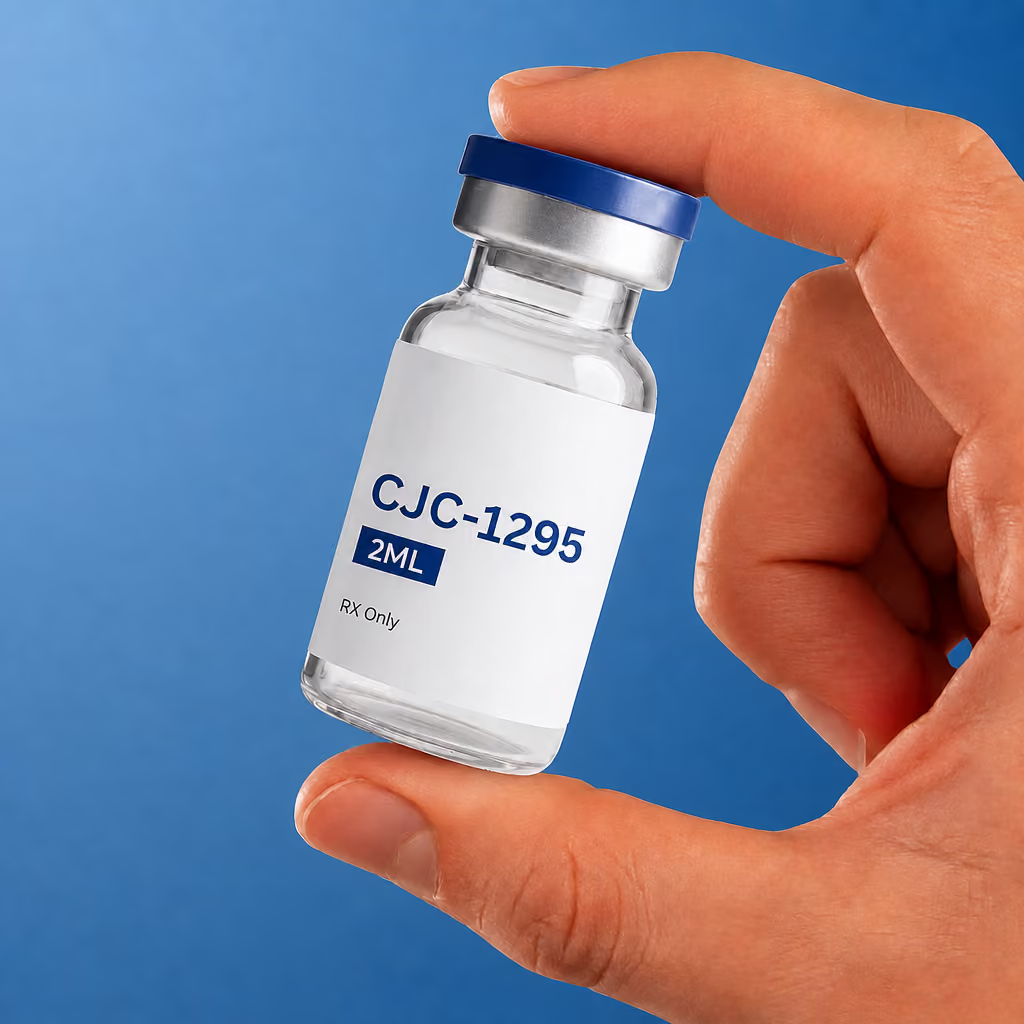
Most CJC-1295 prescriptions arrive as a vial of freeze dried powder that you mix with sterile water at home. That leaves you with a small but important maths problem: how much liquid to draw up so that you inject exactly the dose your prescriber ordered. This guide walks through that calculation step by step, with worked examples and a mixing chart. It does not tell you what dose to take. Your prescriber sets the dose, frequency and duration, and the overview of how that decision is made is in our CJC-1295 dosage guide.
CJC-1295 is not approved by the FDA for any use. It is prescribed at a licensed physician's discretion after a medical review. This article is educational and is not medical advice.
What the Research Used, and Why There Is No Standard Dose
CJC-1295 has never been approved by the FDA, so there is no official dose on a drug label. The published human studies dosed by body weight. In healthy adults aged 21 to 61, researchers gave single or repeated injections and found CJC-1295 safe and relatively well tolerated, particularly at doses of 30 or 60 mcg per kg, with repeated doses given weekly or every other week over 28 to 49 days. A second study in healthy young men used 60 or 90 mcg per kg.
To put that in perspective, 30 mcg per kg for someone weighing 70 kg works out to about 2.1 mg. That figure is shown only to explain the research, not as a recommendation. Doses you may see online, such as fixed weekly amounts tied to goals like anti aging or athletic recovery, do not come from clinical trials. Your prescriber will choose a dose based on your history, labs and response, and adjust it using follow up blood tests.
The Units You Need to Know
- Milligram (mg): one thousandth of a gram. Vials are usually labelled in milligrams.
- Microgram (mcg): one thousandth of a milligram. 1 mg equals 1,000 mcg. Doses are often written in micrograms.
- Millilitre (mL): the volume of liquid. 1 mL is the same as 1 cc.
- Units on an insulin syringe: a U100 insulin syringe is marked so that 100 units equal 1 mL. So 10 units is 0.1 mL and 50 units is 0.5 mL.
The most common and most dangerous mistake is confusing milligrams and micrograms. Writing 0.1 mg as 100 mcg is correct; reading 100 mcg as 100 mg would be a thousandfold overdose. If your prescription and your vial use different units, convert them before you do anything else.
Step 1: Work Out the Concentration
When you add bacteriostatic water to the powder, the peptide dissolves evenly through the liquid. The concentration tells you how much peptide is in each millilitre:
Concentration (mg per mL) = peptide in the vial (mg) ÷ water added (mL)
For example, a 2 mg vial mixed with 2 mL of bacteriostatic water gives 1 mg per mL. The same vial mixed with 1 mL gives 2 mg per mL. Adding more water makes each dose a larger, easier to measure volume; adding less makes it smaller. Your pharmacy label or prescriber will usually tell you exactly how much water to add, and you should follow that rather than choosing your own volume.
Step 2: Work Out the Volume to Draw
Once you know the concentration, divide your prescribed dose by it:
Volume to draw (mL) = your dose (mg) ÷ concentration (mg per mL)
Then convert to syringe units if you are using a U100 insulin syringe:
Units = volume (mL) × 100
Frequently Asked Questions
How do I calculate my CJC-1295 dose in units?
Work out the concentration by dividing the milligrams in the vial by the millilitres of water added. Divide your prescribed dose in milligrams by that concentration to get millilitres, then multiply by 100 to get units on a U100 insulin syringe.
How many units is 100 mcg of CJC-1295?
It depends on how the vial was mixed. With a 2 mg vial mixed in 2 mL of water, 100 mcg is 0.1 mL, which is 10 units on a U100 syringe. Use your own vial strength and water volume to check.
How much bacteriostatic water should I add?
Follow the volume on your pharmacy label or your prescriber's instructions. Changing the water volume changes the concentration and therefore every dose you draw.
What dose of CJC-1295 is standard?
There is no FDA approved dose. Published studies used weight based doses of 30 to 60 mcg per kg in healthy adults. Your prescriber chooses your dose based on your history and lab results.
Is CJC-1295 with DAC dosed the same as without DAC?
No. The DAC form lasts days and is given infrequently, while the form without DAC is cleared quickly and usually given more often. Never substitute one for the other without a new prescription.
What should I do if I calculated the dose wrong?
If you think you injected too much, contact your prescriber the same day and watch for flushing, a fast heartbeat or lightheadedness. Seek emergency care for chest pain or fainting.
Worked Examples
Example 1. A 2 mg vial is mixed with 2 mL of water, so the concentration is 1 mg per mL. The prescribed dose is 100 mcg, which is 0.1 mg. Volume = 0.1 ÷ 1 = 0.1 mL. On a U100 syringe that is 10 units.
Example 2. A 5 mg vial is mixed with 2.5 mL, giving 2 mg per mL. The prescribed dose is 500 mcg, which is 0.5 mg. Volume = 0.5 ÷ 2 = 0.25 mL, or 25 units.
Example 3. A 10 mg vial is mixed with 5 mL, giving 2 mg per mL. The prescribed dose is 2 mg. Volume = 2 ÷ 2 = 1 mL, or 100 units, which fills a 1 mL insulin syringe.
These examples show how the arithmetic works. They are not dose recommendations, and your own numbers will depend on your prescription and your vial.
Mixing Chart
Peptide in vialBacteriostatic water addedConcentrationExample doseVolume to drawUnits on a U100 insulin syringe2 mg2 mL1 mg per mL100 mcg (0.1 mg)0.1 mL10 units2 mg1 mL2 mg per mL100 mcg (0.1 mg)0.05 mL5 units5 mg2.5 mL2 mg per mL500 mcg (0.5 mg)0.25 mL25 units5 mg5 mL1 mg per mL1 mg1 mL100 units10 mg5 mL2 mg per mL2 mg1 mL100 units
All figures in the chart are illustrative. Always use the vial strength and water volume printed on your own pharmacy label.
How to Mix the Vial
- Check the label: confirm the peptide name, strength, expiry date and how much water to add.
- Clean the stoppers: wipe the rubber tops of both vials with an alcohol swab and let them dry.
- Add the water slowly: draw up the stated volume of bacteriostatic water and let it run gently down the inside wall of the peptide vial rather than spraying it onto the powder.
- Swirl, do not shake: roll the vial gently between your hands until the powder dissolves. Shaking can damage the peptide.
- Check the solution: it should be clear. Do not use it if it is cloudy, discoloured or contains particles.
- Label the vial: write the date you mixed it and the concentration on the vial.
Store the mixed vial as your pharmacy directs, usually in the refrigerator. Our guide to how to store and handle CJC-1295 explains how long a mixed vial lasts and what to do if it gets warm.
With DAC and Without DAC
Make sure you know which form you have been prescribed. CJC-1295 with DAC binds albumin in the blood and has an estimated half life of 5.8 to 8.1 days, which is why it is given infrequently. The version without DAC, often called modified GRF 1-29, is cleared much faster and is usually prescribed more often. The two are not interchangeable: the same number of milligrams of each will not have the same effect, so never substitute one for the other without a new prescription.
Common Calculation Errors
- Mixing up mg and mcg: convert everything to the same unit before calculating.
- Using the wrong syringe: insulin syringes come in U100 and other markings; this guide assumes U100.
- Adding a different water volume: if you add more or less water than the label says, every dose changes.
- Reading the wrong line: small syringes have fine markings; use good light and check twice.
- Air bubbles: large bubbles mean you are injecting less liquid than you think; tap them out before checking the dose.
Before your first injection, ask your pharmacist or prescriber to confirm your calculation and show you the correct line on your syringe. Then follow our subcutaneous injection technique guide for the injection itself.
A Quick Way to Check Your Work
Before every new vial, run a reverse check. Take the volume you plan to draw, multiply it by the concentration, and confirm the answer matches your prescribed dose. For example, 0.25 mL at 2 mg per mL is 0.5 mg, which is 500 mcg. If the reverse check does not match, stop and recalculate. Writing the concentration and your dose in units on the vial label means you only need to do the full calculation once per vial.
Safety and Monitoring
Getting the volume right matters because CJC-1295 lasts for days, so an overdose cannot be quickly reversed. The FDA has cited serious adverse events including increased heart rate and systemic vasodilatory reaction with CJC-1295. If you think you have injected more than prescribed, contact your prescriber the same day and watch for flushing, a racing heartbeat or lightheadedness. Our guide to CJC-1295 side effects and safety covers what to watch for.
Conclusion
Calculating a CJC-1295 dose comes down to three steps: work out the concentration from the vial strength and water volume, divide your prescribed dose by that concentration, and convert the volume to syringe units if you use a U100 insulin syringe. The most important safeguard is keeping milligrams and micrograms straight. Remember that the dose itself comes from your prescriber, not a chart, and that published studies used weight based doses rather than the goal based protocols often seen online. If you would like a physician to prescribe and supervise your treatment, you can start your online assessment.
In this article